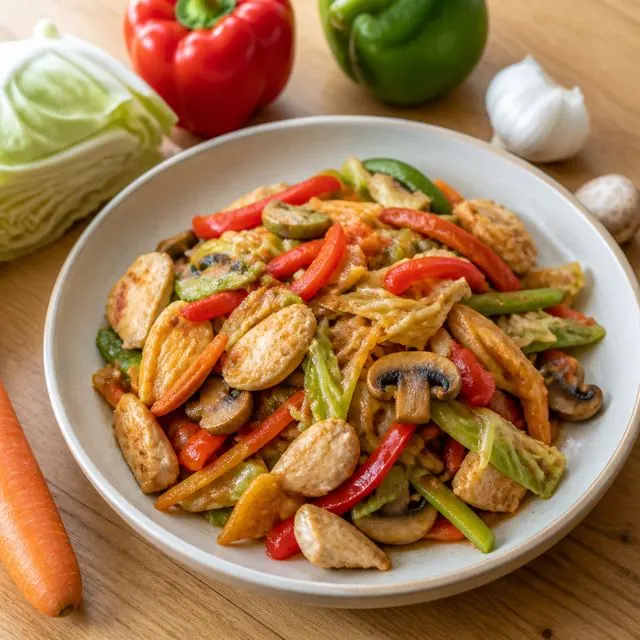
Chicken and vegetable stir-fry
This is the stir-fry for the half cabbage and lonely carrot in your fridge. Mushrooms bring meaty depth, the cabbage turns sweet in just 2 minutes, and a two-ingredient honey soy glaze ties it together at around 320 kcal and 38 g of protein a serving.
- 20 minTotal time
- 2Servings
- 320kcal / serving
- 38 gProtein

The science hook is timing. Each ingredient enters the pan at the exact moment its chemistry wants: chicken first to brown, mushrooms early so their water boils away, garlic and ginger late so they turn fragrant instead of bitter, and the honey last because its sugar browns faster than you'd think.
The science: why this works
- Chicken breast proteins tighten in stages: myosin sets around 50°C (122°F), and above about 66°C (150°F) actin contracts and squeezes out juice. Thin strips race through that window, so pulling them the moment they hit 74°C (165°F) is the difference between juicy and chalky.
- Mushrooms are about 90% water. Adding them in step 2 gives them 3 minutes to release and boil off that liquid before the sauce goes in, so the glaze isn't diluted. Their glutamates and guanylates also team up with soy sauce's glutamates for a bigger umami hit than either alone.
- Cabbage holds sulphur compounds that turn eggy and harsh with long cooking. Two minutes is enough to soften the shreds and bring out their sweetness while staying well short of that sulphurous stage.
- Garlic and ginger go in with the cabbage rather than at the start because their tiny, low-moisture pieces scorch within a minute or two in an empty hot pan. Surrounded by wet cabbage they bloom gently, and ginger's gingerols stay sharp and fresh.
- Honey is rich in fructose, which starts to caramelize at around 110°C (230°F), far lower than table sugar at about 160°C (320°F). That's why the sauce gets only 1 minute: long enough to thicken, short enough not to scorch.
Why the pan needs high heat
High heat browns the chicken fast and keeps vegetables crisp-tender. Cooking in a very hot pan sears the surface before the inside dries out. Keep the food moving so it browns without burning. Cooking in small amounts keeps the pan hot, so food sizzles rather than steams.
Learn: Wok hei: the smoky wok flavor →Why the vegetables go in order
Dense vegetables like carrot need more time than cabbage. Adding the slowest ones first and the quickest last means everything finishes together, with none of it raw or mushy. Lay out all your chopped ingredients before the pan gets hot.
Learn: Stir-fry order: slowest first →Why the sauce turns glossy
Soy sauce and honey cook down quickly in the hot pan. The sugars thicken and coat the food in a shiny glaze while the soy adds salt and savory depth. Taste near the end, because concentrating a sauce also concentrates its salt.
Learn: Why reducing strengthens a sauce →Chicken and vegetable stir-fry
20 minutes · 2 servings · Chinese · Dinner
Ingredients
Makes 2 servings
- 300 gchicken breast, cut into thin strips
- 1bell pepper, sliced
- 1carrot, thinly sliced
- 100 gmushrooms, sliced
- 150 gcabbage, shredded
- 2 clovesgarlic, chopped
- 1 tspgrated ginger
- 2 tbspsoy sauce
- 1 tbsphoney
- 1 tbspvegetable oil
Method

Tips for the best result
- Freeze the chicken breast for 15–20 minutes before slicing. Firm meat cuts into neat, thin strips far more easily.
- Heat the pan until a drop of water skitters and vanishes in a second or two, then add the oil and wait until it shimmers.
- Once the chicken goes in, leave it alone for 60–90 seconds before the first stir so the underside can actually brown.
- Slice the carrot on a sharp diagonal about 3 mm thick. More surface means it softens in its 3-minute slot.
- Wipe mushrooms with a damp towel instead of rinsing them; they soak up water that would otherwise end up in the pan.
- Stir the soy sauce and honey together in a cup so the honey is loosened and coats everything in one pour.
Mistakes to avoid
- Adding garlic at the very start with the chicken — it burns and turns bitter in the empty pan; wait for the cabbage as the recipe says.
- Cooking the chicken an extra few minutes "to be safe" — check the thickest strip at the 5-minute mark and move on once it reads 74°C (165°F).
- Letting the cabbage go floppy — stop at 2 minutes, when the edges have wilted but the thick ribs still have a little snap.
- Leaving the glazed stir-fry sitting on the hot burner — honey keeps browning; turn the heat off as soon as everything is glossy.
Variations and swaps
- Use pressed, cubed firm tofu instead of chicken, and maple syrup instead of honey, for a vegan version.
- Make it gluten-free with tamari labelled gluten-free in place of the soy sauce.
- Swap in peeled shrimp, added after the vegetables and cooked 2–3 minutes until pink, opaque and firm.
- For a thicker, saucier finish, stir 1 tsp cornstarch into 2 tbsp water and add it with the soy and honey.
- Finish with a few drops of toasted sesame oil, sesame seeds and sliced green onion.
- Swap the chicken breast for thinly sliced thigh meat for more juicy results.
Storing and reheating
Refrigerate within 2 hours (1 hour above 32°C/90°F) in an airtight container at 4°C (40°F) or below and eat within 3–4 days. To keep the chicken tender, reheat in a hot pan with 1 tbsp of water for 2–3 minutes, which loosens the glaze, or microwave covered at half power, stirring every minute, until steaming and 74°C (165°F) throughout. It freezes for 2–3 months at −18°C (0°F), but the cabbage and peppers turn soft, so it's best as a sauce-heavy rice topper after thawing in the fridge. Store any rice separately, cool it fast and eat it within a day or two.
Chicken and vegetable stir-fry: questions
Can I make this in a regular frying pan instead of a wok?
Yes. Use your widest frying pan or cast iron skillet, preheat it well and cook the chicken in two batches if it can't sit in one layer.
Is the chicken done as soon as it turns white?
Not always. The outside whitens first, so cut the thickest strip open: there should be no pink, the juices should run clear and it should read 74°C (165°F).
Why does my garlic taste bitter?
It burned. Minced garlic scorches in under a minute in a dry, very hot pan, so add it with a wet vegetable like the cabbage here.
How do I make the sauce thicker?
Mix 1 tsp cornstarch into 2 tbsp cold water and stir it in with the soy and honey. It thickens to a coating sauce within a minute of bubbling.
Is soy sauce gluten-free?
Regular soy sauce is brewed with wheat, so it isn't. Swap in tamari labelled gluten-free to make the whole dish gluten-free.
Is this good for meal prep?
Yes. Portion it into containers with rice kept separate and eat within 3–4 days; the vegetables soften a little but the flavour holds up well.
How do you keep chicken tender in a stir fry?
Cut it into thin even strips and do not overcook it. Cooking for about 5 minutes over high heat gives golden, juicy chicken.
Why is my stir fry soggy?
A crowded or too-cool pan steams the food instead of searing it. Use a large pan on high heat and work in batches if needed.
Can I use frozen vegetables?
Yes, but thaw and pat them dry first so they do not release extra water. Add them near the end of cooking.