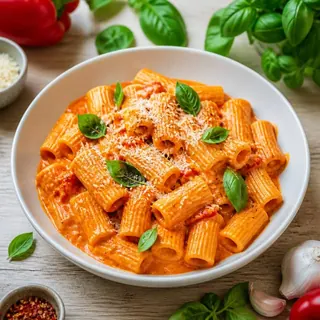
Creamy pesto chicken penne
Three tablespoons of jarred pesto stretch a long way once cream and parmesan join in. The cream softens pesto's raw-garlic edge and turns a thick paste into a pourable sauce, while chicken seared in 2 cm pieces brings a browned crust that poached or shredded chicken never has.
- 25 minTotal time
- 2Servings
- 820kcal / serving
- 48 gProtein
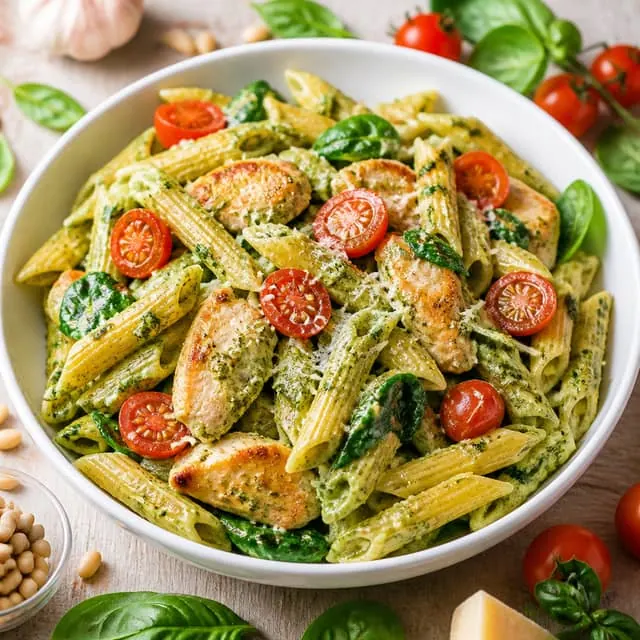

This is a high-protein pasta, 48 g a serving for two, built on four moves: boil, sear, simmer, toss. Start the chicken as the penne goes into the water and the two finish within a minute of each other, and the recipe is forgiving if they drift a little apart.
The science: why this works
- Chicken breast proteins tighten in stages: myosin sets at roughly 50 to 55°C (122 to 131°F), and actin at about 66 to 73°C (150 to 163°F), which is when most of the juice gets squeezed out. Small 2 cm pieces cross that range fast, so the 6 to 7 minute window is tight on purpose.
- Chicken is rich in inosinate, and parmesan and tomatoes are rich in glutamate. Together they produce umami synergy, a savoury hit stronger than either would give alone, which is why such a short ingredient list tastes so full.
- When the tomatoes go into the chicken pan, their juice is both water and acid, and it lifts the browned residue the chicken left behind. That fond ends up in the cream instead of in the sink.
- Basil's perfume comes from volatile compounds such as linalool and eugenol, which escape the hotter and longer the sauce cooks. Giving the pesto just a gentle simmer and 1 to 2 minutes of tossing warms it without driving off the aroma.
Salting the pasta water
Pasta absorbs water as it boils, and salty water seasons it from the inside. Unsalted pasta tastes flat no matter how good the sauce is. About 1 tablespoon of salt for a big pot is a good start.
Learn: Salt the pasta water →Finishing the pasta in the sauce
Cooking the penne 1 minute short lets it finish in the sauce. It soaks up flavor while the starch it releases helps the cream cling. That is why the sauce turns glossy rather than watery.
Learn: Finishing pasta in the sauce →Starchy pasta water as a thickener
Pasta water holds dissolved starch and salt. A splash loosens thick sauce without thinning the flavor, and the starch helps fat and water stay blended into one smooth sauce. An emulsion is simply fat and water held together in a smooth mixture.
Learn: How emulsions work →Creamy pesto chicken penne
25 minutes · 2 servings · Italian · Dinner
Ingredients
Makes 2 servings
- 200 gpenne
- 2 lwater, for boiling
- 300 gchicken breast, cut into 2 cm pieces
- 2 clovesgarlic, chopped
- 150 gcherry tomatoes, halved
- 3 tbsppesto
- 100 mlheavy cream
- 60 gspinach
- 30 gparmesan, grated
- 1 tbspolive oil
- Salt
- Black pepper
Method

Tips for the best result
- Start the chicken at the same time as the penne goes in, so pan and pot finish together.
- Pat the chicken pieces dry and season them just before they hit the pan; salted chicken left sitting goes wet on the surface.
- Leave the pieces untouched for the first 2 minutes so they release from the pan with a golden underside.
- Stir the pesto jar well before measuring; the oil rises to the top and the first spoonfuls are mostly oil.
- Stand the mug next to the colander before you drain, so the pasta water can't be forgotten.
- Add the spinach in two handfuls; the first wilts in about 30 seconds and makes room for the second.
Mistakes to avoid
- Crowding the chicken — 300 g in a pan under 26 cm (10 in) steams instead of browning; use your largest pan or cook in two batches.
- Adding the parmesan over high heat — it clumps into rubbery strings; keep the heat low and toss it in with the penne.
- Cooking the tomatoes to mush — 2 minutes is enough; they should soften and just start to split, adding juice without disappearing.
- Letting the finished pasta sit in the pan — penne keeps drinking the sauce, so serve it straight away.
Variations and swaps
- Use leftover rotisserie chicken, stirred in with the cream just until it's heated to 74°C (165°F).
- Swap basil pesto for sun-dried tomato pesto (pesto rosso) for a sweeter, deeper sauce.
- Replace the cream with 60 g cream cheese, loosened with pasta water.
- Scatter toasted pine nuts or chopped walnuts over each bowl for crunch.
- Use gluten-free penne and a pesto labelled gluten-free, and pull the pasta at the low end of the packet time, since it softens quickly in sauce.
- Swap penne for fusilli or rigatoni, since the ridges hold sauce well.
Storing and reheating
Refrigerate leftovers within 2 hours and eat within 3 to 4 days at 4°C (40°F) or below. The chicken is the part most likely to dry out on reheating, so microwave portions covered at 50% power, stirring halfway, with 2 tbsp of milk or water per portion, until steaming and 74°C (165°F) throughout. Reheated pesto tastes flatter because its basil aroma has faded, so stir in a fresh teaspoon of pesto after reheating to bring it back. Skip the freezer: the cream sauce turns grainy and the penne softens once thawed.
Creamy pesto chicken penne: questions
Why does my pesto pasta turn brown or dull?
Heat and time break down basil's chlorophyll, so the colour fades the longer the sauce stays hot. Serve straight after tossing, and brighten leftovers with a fresh spoonful of pesto.
Can I make it without cream?
Yes. Cream cheese loosened with pasta water gives the closest result, while milk alone tends to split and makes a thinner sauce.
How can I tell the chicken is cooked through?
It's safe at 74°C (165°F) in the thickest piece. Without a thermometer, cut the largest piece open and check that no pink remains and the juices run clear.
Can I meal prep creamy pesto pasta?
Yes, for up to 3 to 4 days in the fridge. Cook the penne 2 minutes short, pack each portion with an extra spoonful of pasta water, and it will loosen back into a sauce when reheated.
Does jarred pesto contain nuts?
Most do: pine nuts are traditional, and many brands use cashews or almonds instead. For a nut allergy, look for a nut-free pesto, which usually uses sunflower or pumpkin seeds.
How do I keep chicken from drying out in pasta?
Cook the chicken until it is just done at 165°F (74°C) and do not keep it cooking in the sauce for long. Searing in a hot pan keeps the outside golden. Slicing it after a short rest also keeps it juicy.
Can I use store-bought pesto?
Yes, jarred or fresh store-bought pesto works well in this recipe. Taste first, since some brands are salty, and go easy on added salt. Stir it in over low heat so it stays bright.
Why does my cream sauce look split?
A split sauce usually happens when cream boils too hard or too fast. Keep the heat low and stir. A splash of pasta water and a bit of whisking can bring it back together.