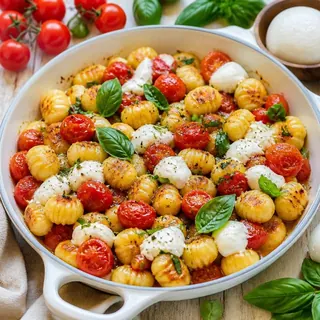
Creamy Tuscan sausage gnocchi
Italian sausage is a shortcut ingredient in disguise. It arrives already seasoned with salt, garlic and often fennel, so the fat it renders flavours everything cooked after it. Here that fat softens the onion, the broth and cream pick up the seasoning, and vacuum-packed gnocchi drink in the sauce as they plump.
- 30 minTotal time
- 3Servings
- 720kcal / serving
- 26 gProtein
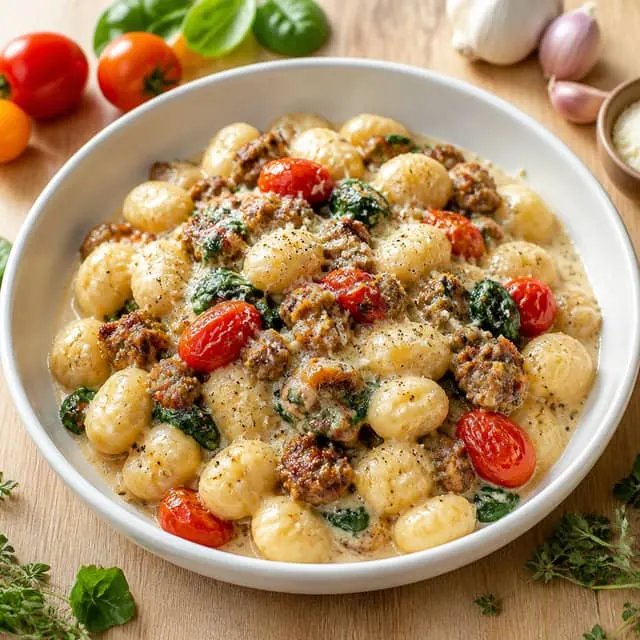

It feeds three hungry people and sits firmly on the rich side, about 720 kcal a portion, so think cold-night dinner rather than light lunch. The spinach goes in last, which makes it the easiest part to swap for whatever greens are wilting in your fridge.
The science: why this works
- Pork fat starts to soften and render at roughly 30 to 45°C (86 to 113°F), well below browning heat, so the sausage releases its own cooking fat early. Fennel, garlic and pepper flavours are largely fat-soluble, and that fat carries them into the onion.
- Slicing the garlic instead of mincing it breaks fewer cells. Fewer broken cells means less of the enzyme alliinase meets its partner alliin, so less sharp allicin forms and the garlic tastes mellow and sweet after its 2 minutes in the pan.
- Shelf-stable gnocchi are cooked and pasteurized in the pack, so their starch is already gelatinized. The 4 to 5 minute simmer is really reheating and rehydrating, and the lid matters: it traps steam so the tops poking out of the sauce heat as fast as the submerged undersides.
- Parmesan is aged for a year or more, and in that time its proteins are broken into shorter pieces and free glutamate. That is why it dissolves into the sauce instead of stretching into strings like a young mozzarella would, and why a modest 30 g adds so much savouriness.
- Spinach is about 90% water held up by stiff cell walls. Heat collapses those walls in under a minute, so 100 g shrinks to a few spoonfuls and lets go of a little liquid that the gnocchi immediately absorb.
Browning the sausage first
Sausage browns best in a hot, uncrowded pan. The browned bits that stick to the pan are packed with savory flavor, and the cream and broth lift them into the sauce later. Cooking until no pink remains also makes it safe at 160°F (71°C).
Learn: Maillard vs. caramelization →Gnocchi cooked in the sauce
Gnocchi hold a lot of starch. As they simmer in the broth and cream, some starch leaks out and thickens the liquid. That is why the sauce turns glossy and clingy without any flour. Starch granules swell with liquid and heat, which is what thickens the sauce.
Learn: How starch thickens sauce →A gentle simmer for the cream
Cream has plenty of fat, so it handles heat well, but a hard boil can make a sauce look greasy or split. Keeping it at a gentle simmer holds the fat and water together in a smooth emulsion.
Learn: How emulsions work →Creamy Tuscan sausage gnocchi
30 minutes · 3 servings · Italian · Dinner
Ingredients
Makes 3 servings
- 300 gItalian sausage, casings removed
- 500 ggnocchi
- 1onion, diced
- 3 clovesgarlic, sliced
- 200 gcherry tomatoes, halved
- 250 mlchicken broth
- 150 mlheavy cream
- 100 gspinach
- 30 gparmesan, grated
- 1 tbspolive oil
- Salt
- Black pepper
Method

Tips for the best result
- Use a frying pan at least 28 cm (11 in) wide so the gnocchi fit in close to a single layer and heat evenly.
- Separate any gnocchi that are stuck together in the pack before they go in; fused clumps stay dense and cool in the middle.
- If the sausage renders more than about 1 tbsp of fat, spoon the extra off before the onion goes in, or the finished sauce will look oily.
- Listen for the tomatoes: a soft pop and hiss means the skins have split and the pan is ready for the broth.
- Grate the parmesan finely on a rasp grater. Fine shreds melt into the sauce in seconds; coarse chunks stay chewy.
- Press a gnocchi with the back of a spoon to check it: ready ones feel springy and soft all the way through, not firm in the centre.
Mistakes to avoid
- Treating fresh or frozen gnocchi like shelf-stable ones — fresh refrigerated gnocchi need only 2 to 3 minutes, while frozen ones need 2 extra minutes and a splash more broth.
- Lifting the lid again and again — every peek lets the steam out and leaves the tops hard; stir once halfway, then cover and leave it.
- Adding the parmesan to a hard-bubbling sauce — drop the heat to low first so the cheese melts smoothly instead of seizing into clumps.
- Salting at the start — sausage, broth and parmesan all concentrate as the sauce reduces, so season only after the cheese is in.
Variations and swaps
- Add 3 or 4 chopped sun-dried tomatoes with the garlic for a sweeter, deeper tomato note.
- Use hot Italian sausage, or add ½ tsp chili flakes with the garlic, for a version with a kick.
- Fold in a drained 400 g can of cannellini beans with the gnocchi to stretch it to four servings.
- Trade the spinach for 100 g baby arugula, stirred in off the heat, for a peppery finish.
- Make it meat-free with plant-based sausage, vegetable broth and a vegetarian hard cheese in place of parmesan.
- Swap Italian sausage for chicken sausage to make it lighter, and add a little extra oil for browning.
Storing and reheating
Refrigerate leftovers within 2 hours and eat them within 3 to 4 days, kept at 4°C (40°F) or below. Overnight the gnocchi soak up most of the sauce, so the dish looks tight and set straight from the fridge; that is normal. To bring it back, add 2 to 3 tbsp broth per portion and reheat over medium-low, covered, stirring once, until steaming and 74°C (165°F) in the centre; high heat makes the reheated cream sauce turn oily. For a second-day upgrade, spread leftovers in a baking dish, scatter over a little extra parmesan and bake at 200°C (400°F) for about 15 minutes until bubbling and golden on top. Skip the freezer, because the cream sauce turns grainy once thawed.
Creamy Tuscan sausage gnocchi: questions
Can I use frozen or fresh gnocchi instead of shelf-stable?
Yes, with small timing changes. Fresh refrigerated gnocchi cook in 2 to 3 minutes, and frozen gnocchi can go straight in from frozen with 2 extra minutes and a splash more broth, because they cool the sauce down.
Does cauliflower gnocchi work in a creamy sauce?
It works, but it softens quickly and won't thicken the sauce the way potato gnocchi do. Pan-fry it separately until golden, then fold it in with the spinach at the end.
Why did my gnocchi turn mushy?
They were most likely simmered too long or the sauce boiled hard. Pre-cooked gnocchi only need to heat through and puff; after that, their surface keeps absorbing liquid until it breaks down.
How can I tell the sausage is fully cooked?
Pork sausage is safe at 71°C (160°F). Without a thermometer, break open a few of the larger crumbles and make sure no pink remains; chicken or turkey sausage needs 74°C (165°F).
Can I make Tuscan gnocchi without cream?
Yes. Whole milk with 2 tbsp cream cheese whisked in gives a similar body as long as you keep the heat low, and full-fat oat cooking cream with a dairy-free hard cheese makes a dairy-free version.
Do I need to boil gnocchi before adding them to the sauce?
No, shelf-stable gnocchi can go straight from the pack into the simmering sauce. They cook in 4 to 5 minutes and release starch that thickens the sauce. Just keep the pan covered and stir once.
What can I use instead of Italian sausage in Tuscan gnocchi?
Chicken sausage, turkey sausage or crumbled plant-based sausage all work well. Brown them the same way until no pink remains. Meat sausages should reach 160°F (71°C) for ground pork or beef, or 165°F (74°C) for poultry.
Why is my gnocchi sauce thin?
The sauce is usually thin because it did not simmer long enough or too much liquid was added. Let it bubble gently for another minute or two, and stir in the parmesan, which also thickens it. The gnocchi starch will help too.