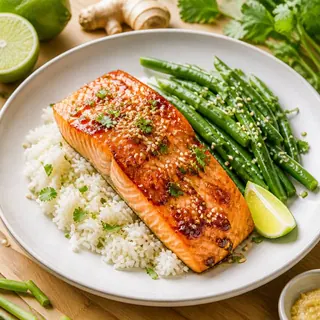
Salmon
Salmon cooks easily due to low connective tissue, retaining juiciness with its natural fat.
Salmon is a rich, oily fish from the cold waters of the North Atlantic and Pacific, sold as fresh fillets, steaks, smoked slices and canned. Its flesh is buttery and gently briny, with an ocean-fresh aroma and a mild earthy depth that turns lightly smoky when grilled or seared.
Cooks love salmon because it is so easy to get right. Its natural fat keeps it moist, it takes on glazes and marinades in minutes, and it is just as good cured as gravlax, flaked into rice bowls or roasted whole for a crowd.
Flavor profile
Aroma: briny, ocean, rich
Good to know
Origin: North Atlantic and Pacific Oceans
Forms: fresh, smoked, canned
Season: Farmed salmon is available year-round; wild Pacific salmon is at its best from late spring to early autumn.
Nutrition: A good source of protein; like all oily fish, it also provides omega-3 fats.
Storage: Keep raw salmon in the coldest part of the fridge and cook it within 1–2 days. Wrapped tightly or vacuum-sealed, it freezes for 2–3 months; thaw it overnight in the fridge, never on the counter. Cooked salmon keeps 3–4 days chilled and is lovely flaked cold into salads. Smoked salmon lasts until its use-by date unopened but only a few days once opened. A slimy surface, dull colour or sharp ammonia smell means it has gone off.
How to use salmon
Grilling Goodness
Grill it, letting omega-3 fats melt and keep it luscious while boosting flavor.
Gravlax Game
Salt and sugar pulls moisture out, curing the fish and sweetening it subtly.
The science of salmon
- Fish muscle has very little collagen compared with land animals, and what it has melts at a low temperature. That is why salmon flakes so easily and needs only minutes of cooking.
- The white goo that sometimes appears on cooked salmon is albumin, a protein pushed out of the muscle as it tightens. Gentler heat and a lower finishing temperature keep more of it inside.
- Salmon's orange-pink colour comes from astaxanthin, a carotenoid pigment from the krill and shrimp in its diet. It is fat-soluble, so it stays in the flesh rather than leaching into cooking liquid.
- Curing salmon with salt and sugar draws water out of the flesh by osmosis and firms the proteins, turning raw fish into silky gravlax without any heat.
- Salmon's oil is rich in unsaturated fats that oxidise quickly, which is where that strong fishy smell in older fish comes from. Acid from lemon or vinegar helps tame those aroma compounds on the plate.
How to choose salmon
Fresh salmon should smell clean and briny, never sour or strongly fishy. The flesh should be moist, glossy and firm enough to spring back when pressed, without gaps between the flakes. Frozen-at-sea fillets are often fresher than tired fish on ice, and wild salmon is leaner and deeper red than farmed.

Substitutes for salmon
| Swap | Amount | What changes |
|---|---|---|
| Arctic char | 1:1 | A close cousin with similar colour and richness, slightly milder and thinner. |
| Ocean trout | 1:1 | Pink, oily and cooks the same way in any salmon recipe. |
| Mackerel | 1:1 | Oilier and stronger-tasting; great with sharp acids and grilling. |
| Halibut | 1:1 | A leaner white fish; cook it a little less and add butter or oil. |
What goes with salmon
- Dill. Dill's fresh, caraway-like aroma cuts through salmon's rich, oily flesh.
- Lemon. Lemon's acidity cuts through salmon's richness, refreshing the palate.
- Capers. Capers' briny tang adds contrast to rich salmon.
- Asparagus. Asparagus's green, fresh flavor cuts the oiliness of roasted salmon.
- Miso. Miso's salty sweet umami seasons and glazes salmon's oily flesh.
- Soy Sauce. Soy sauce's umami balances salmon's natural richness and fattiness.
- Maple Syrup. Maple syrup caramelizes on salmon, adding sweetness to its oily texture.
- Fennel Bulb. Fresh anise notes and crunch lighten salmon's oily richness.
- Ginger. Ginger's fresh heat balances salmon's oily richness.
- Grapefruit. Grapefruit's sharp bitterness cuts through salmon's oily flesh.
Mistakes to avoid
- Overcooked salmon ends up as dry as cardboard. Don't do that.
- Miss the pin bones, and you'll have an unwelcome crunch.
Ideas for tonight
- Pan-seared salmon with dill
- Smoked salmon on bagels
- Baked salmon with lemon
Salmon: questions
What internal temperature should salmon be cooked to?
Food-safety guidance is 63°C (145°F). Many cooks pull salmon at about 50–52°C (122–126°F) for a silky, just-opaque centre, but that is a choice to make with very fresh, high-quality fish.
What is the white stuff on cooked salmon?
It is albumin, a harmless protein that squeezes out as the muscle fibres contract. Cooking more gently, or briefly brining the fish in salted water first, keeps most of it in.
How long does it take to bake salmon?
A typical 2–3 cm (1 inch) fillet takes about 12–15 minutes in a 200°C (400°F) oven. Check early, because thinner tail pieces cook faster.
Should you cook salmon skin-side down?
Yes, for pan-searing. The skin protects the delicate flesh from direct heat and turns crisp if you start it in a hot, oiled pan and leave it alone until it releases.
Is wild salmon better than farmed?
They are just different. Wild salmon is leaner, firmer and more deeply flavoured, so it overcooks faster; farmed salmon is fattier, milder and more forgiving.
Can you freeze salmon?
Yes. Wrap it tightly to keep air out and use within 2–3 months for the best texture. Thaw it in the fridge overnight, then pat it dry before cooking.
Do you need to remove pin bones from salmon?
It is worth it. Run your fingers along the fillet to find the thin bones and pull them out in the direction they point with clean tweezers.
What does salmon taste like?
Salmon cooks easily due to low connective tissue, retaining juiciness with its natural fat., with an aroma that is briny, ocean, rich.
What goes well with salmon?
Salmon pairs best with dill, lemon, capers, asparagus, miso. Dill's fresh, caraway-like aroma cuts through salmon's rich, oily flesh.
How do you use salmon in cooking?
Grilling Goodness: grill it, letting omega-3 fats melt and keep it luscious while boosting flavor.
How should you store salmon?
Refrigerate fresh salmon up to 2 days or freeze for longer storage.
What is the most common mistake with salmon?
Overcooked salmon ends up as dry as cardboard. Don't do that.
 Dill
 Lemon
 Miso
 Capers
 Asparagus
 Halibut
 Cod
 Fennel Bulb