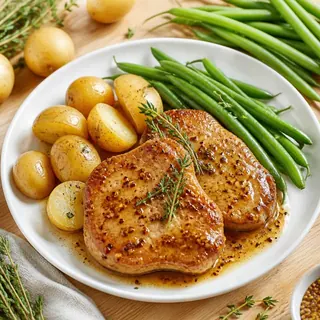
Herb Roasted Pork Tenderloin
Roast pork tenderloin is a lean, quick-cooking cut that turns out juicy and tender when you do not overcook it. A Dijon, garlic and herb coat adds big flavor with almost no work.
- 35 minTotal time
- 4Servings
- 290kcal / serving
- 41 gProtein
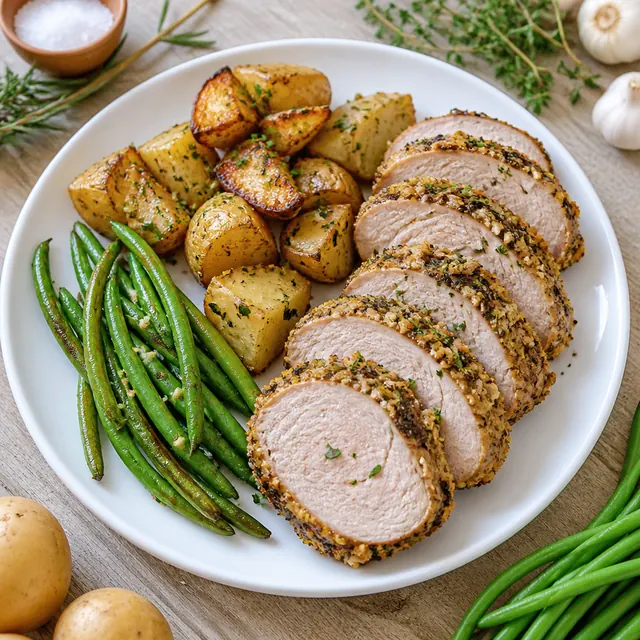

Sear it first for a brown crust, finish it in a hot oven, and pull it at 140°F (60°C). A short rest brings it up to a safe 145°F (63°C) with a blush of pink and plenty of juice.
The science: why this works
- Searing in a hot pan browns the surface through the Maillard reaction before the oven finishes the center.
- Dijon mustard acts as a glue for the herbs and adds acid and a salty tang that cuts through the lean meat.
- Pork tenderloin is very lean, so a short, hot roast cooks it before it dries out.
- Pulling the pork at 140°F (60°C) lets carryover heat finish the cooking to 145°F (63°C) while it rests.
- Resting lets the juices settle so each slice stays moist.
Carryover cooking
Meat keeps cooking after it leaves the oven because the hot outer layer continues to pass heat inward. A tenderloin can rise 5°F (3°C) or more during the rest. Pulling it slightly early means it finishes at 145°F instead of overshooting.
Learn: Carryover cooking →Why pork can be pink
Modern pork is safe at 145°F (63°C), the USDA temperature, and at that point the center can look pale pink. Color depends on myoglobin, not just doneness, so use a thermometer rather than the color to judge.
Learn: Pork doneness →Herb Roasted Pork Tenderloin
35 min · 4 servings · American · Main course
Ingredients
Makes 4 servings
Method

Tips for the best result
- Tuck the thin tail end under, or fold it, so it does not overcook before the thick part is done.
- Leave the pork whole while it roasts and slice only after resting.
- If your tenderloins are very thin, check the temperature at 10 minutes.
Mistakes to avoid
- Overcooking, which turns tenderloin dry and chalky; pull at 140°F (60°C).
- Skipping the rest, which sends juices onto the board; rest 8 to 10 minutes.
- Leaving the silver skin on, which stays chewy and shrinks the meat as it cooks; trim it off.
Variations and swaps
- Swap the herbs for a smoked paprika, brown sugar and garlic rub.
- Roast apples and onions in the pan alongside for an easy side.
- Wrap each tenderloin in bacon for extra richness, and add 5 to 10 minutes.
- Swap fresh herbs for 1 teaspoon each of dried rosemary and thyme.
- Swap Dijon for whole-grain mustard for a more rustic texture.
- Swap butter for a splash of white wine to make a quick pan sauce.
Storing and reheating
Refrigerate sliced pork within 2 hours and eat within 3 to 4 days. Reheat gently in a covered skillet with a splash of broth to 165°F (74°C), or eat cold in sandwiches.
Herb Roasted Pork Tenderloin: questions
What temperature should pork tenderloin be cooked to?
Cook it to 145°F (63°C), followed by a 3-minute rest, according to the USDA. Pull it at 140°F (60°C) and let carryover heat finish the job.
How long do you cook pork tenderloin at 400°F?
About 12 to 18 minutes after a quick sear, depending on thickness. A tenderloin of about 450 g (1 lb) is usually done in 15 minutes.
Is it okay if pork tenderloin is a little pink?
Yes, a slight pink blush is normal and safe at 145°F (63°C). Modern pork is much safer than in the past, and overcooking it only makes it dry.
Do I need to sear pork tenderloin first?
It is not required, but searing adds a browned crust and deeper flavor. Without searing, roast at 425°F (220°C) for 20 to 25 minutes.
What is silver skin and should I remove it?
It is a tough, shiny membrane on the surface of the tenderloin. Slide a thin knife under it and slice it away, because it does not soften when cooked.