Perfect Seared Scallops
Seared scallops have a caramel brown crust and a sweet, almost custardy middle. They look like restaurant food but take under 10 minutes of cooking once the pan is hot.
- 16 minTotal time
- 4Servings
- 260kcal / serving
- 26 gProtein
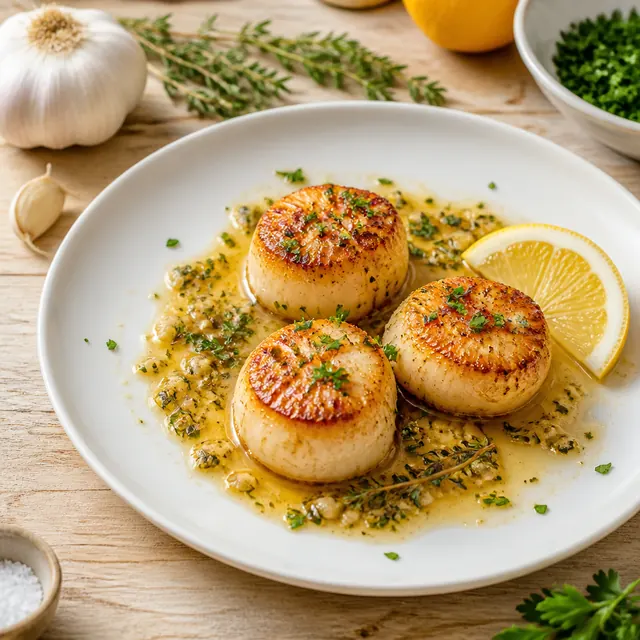

The work is all in the prep: very dry scallops, a very hot pan and no fiddling. Follow those three rules and you will get a perfect sear on the first try.
The science: why this works
- Drying the scallops removes surface water, which would steam them instead of browning them.
- A very hot pan browns the outside in about 2 minutes, before the inside overcooks.
- Leaving them untouched lets a full crust form so they release easily.
- Butter added after the flip gives nutty flavor without burning at the high heat.
- A squeeze of lemon cuts through the rich butter and the natural sweetness of the scallop.
Why dry scallops brown
Browning only happens above 212°F (100°C), the boiling point of water. A wet scallop must first boil off its surface moisture, by which time the inside is overcooked. Patting dry lets the surface hit browning temperature almost at once.
Learn: Sear with a dry, hot pan →The Maillard crust
The golden crust comes from the Maillard reaction, in which proteins and natural sugars in the scallop combine to create hundreds of savory, sweet flavor compounds. Scallops are rich in sugars, so they brown fast and taste sweet.
Learn: Maillard vs. caramelization →Tender at 130°F
Scallop muscle is tender and lean, and it tightens fast. Cooked to about 130 to 135°F (54 to 57°C), it stays silky. Past 145°F (63°C), it turns firm and rubbery, so a short cook time matters more than any other step.
Learn: Cooking fish gently →Perfect Seared Scallops
16 min · 4 servings · French · Main course
Ingredients
Makes 4 servings
- 500 glarge sea scallops (about 12), side muscle removed
- ½ tspkosher salt
- ¼ tspblack pepper
- 1 tbsphigh-heat oil such as avocado or grapeseed
- 2 tbspbutter
- 2 clovesgarlic, smashed
- 2sprigs fresh thyme
- 1 tbsplemon juice
- 1 tbspfresh parsley, chopped
Method

Tips for the best result
- Ask for dry-packed scallops, which sear far better than ones soaked in a salt solution.
- Do not crowd the pan; cook in two batches if needed.
- Do not move the scallops until they release naturally.
Mistakes to avoid
- Starting with a wet scallop steams it gray, so dry it thoroughly.
- Using a nonstick pan at high heat gives a weak crust, so use stainless or cast iron.
- Overcooking beyond 2 minutes per side makes scallops rubbery, so watch the clock.
Variations and swaps
- Serve on creamy risotto or cauliflower puree.
- Add a splash of white wine to the butter for a quick pan sauce.
- Wrap in bacon and bake at 400°F (200°C) for 12 minutes.
- Swap butter for olive oil to keep it dairy free.
- Swap thyme for fresh basil or chives.
- Swap sea scallops for peeled large shrimp, cooked 2 minutes per side.
Storing and reheating
Scallops are best eaten straight away. Refrigerate leftovers within 2 hours for up to 2 days and reheat gently only until hot through to 165°F (74°C), or eat them cold in a salad.
Perfect Seared Scallops: questions
How long do you sear scallops?
Sear large scallops about 2 minutes on the first side and 1 to 1.5 minutes on the second side, in a very hot pan. They should be golden on the outside and just opaque in the center.
Why are my scallops not browning?
They are probably too wet, or the pan is not hot enough or is overcrowded. Dry the scallops well, preheat the pan for several minutes and leave space between each one.
What is the difference between wet and dry scallops?
Wet scallops are soaked in a phosphate solution that adds water weight, so they release liquid and will not sear well. Dry scallops are natural and caramelize beautifully.
What internal temperature for scallops?
The USDA recommends 145°F (63°C), where scallops are opaque and firm. Many cooks pull them at 130 to 135°F (54 to 57°C) for a silkier center and rest briefly.
Can I cook frozen scallops?
Yes. Thaw them in the fridge overnight, then drain and pat very dry. Skip rinsing under hot water, which starts them cooking unevenly.