Garlic butter steak with crispy potatoes
The secret weapon is a spoon. In the last minute, the heat drops, butter, crushed garlic and thyme go in, and you tilt the pan and ladle that foaming, nutty butter over the meat again and again. It perfumes the crust and gently cooks the top surface while the bottom keeps searing.
- 40 minTotal time
- 2Servings
- 780kcal / serving
- 44 gProtein
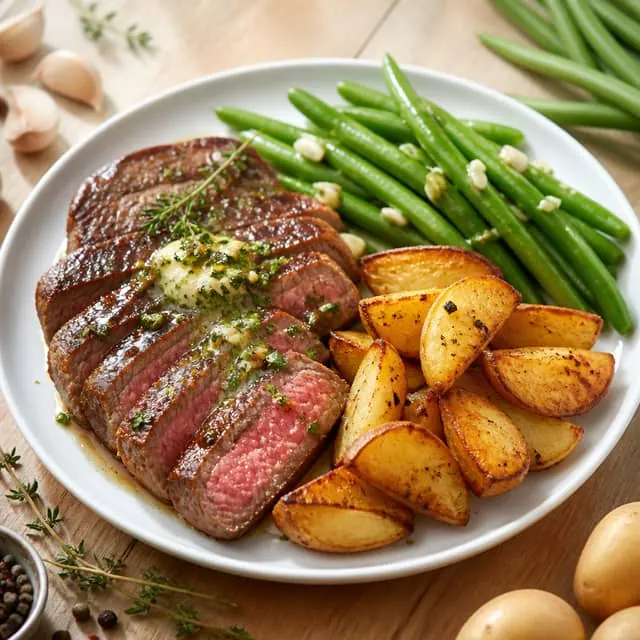

The timing is planned so nothing waits around: the potatoes get a 30-minute head start, the green beans join them for the last 10, and the sirloin cooks in under 10 minutes and rests while you plate. It serves 2, with 44 g of protein each.
The science: why this works
- Butter is roughly 80% fat, 16% water and a little milk protein and sugar. The foaming you see is that water boiling off; once it settles, the milk solids brown fast and turn nutty. One minute of basting catches them at that toasty stage, before they blacken.
- Basting cooks from both sides at once. Hot butter poured over the top surface keeps heat flowing in from above while the pan works from below, so the centre warms more evenly than flipping alone would manage.
- Thyme's main aroma compound, thymol, and many of garlic's flavour compounds dissolve in fat, so hot butter extracts them within seconds. Crushed whole cloves have far less cut surface than minced garlic, so they flavour the butter without scorching.
- Green beans turn olive-drab when long cooking lets acids from their own cells convert bright chlorophyll into a duller pigment. Ten minutes of dry roasting blisters and sweetens them before that change has time to set in.
- During the 5-minute rest the hotter outer layers keep pushing heat inward, raising the centre by roughly 3 to 5°C (5 to 10°F). Pull the steak at about 58°C (136°F) and it coasts to 63°C (145°F), the safe medium-rare minimum.
Roasting potatoes at high heat
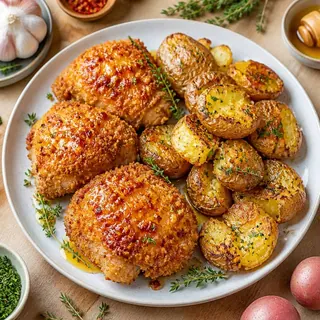
Hot, dry oven air crisps the potato surface while the inside steams soft. Oil helps heat the surface evenly, and turning once browns each side. Spacing them on the tray prevents steaming. Space and high heat turn plain vegetables sweet, browned and full of flavor.
Learn: Don't crowd the roasting pan →A hot pan and a good crust
Patting the steak dry and using a very hot, heavy pan lets the surface brown quickly. That crust brings savory flavor, while the inside stays juicy because the cooking time is short. A dry surface and a hot pan are the two keys to a good crust.
Learn: Sear with a dry, hot pan →Resting the steak
Cooking pushes juices toward the center of the steak. A 5-minute rest lets them settle back through the meat, so slicing does not flood the board. Steak is safe at 145°F (63°C) with a rest.
Learn: Rest meat before cutting →Garlic butter steak with crispy potatoes
40 minutes · 2 servings · American · Dinner
Ingredients
Makes 2 servings
- 350 gsirloin steak
- 500 gsmall potatoes, quartered
- 200 ggreen beans, trimmed
- 30 gbutter
- 3 clovesgarlic, crushed
- 2 sprigsthyme
- 3 tbspolive oil
- Salt
- Black pepper
Method

Tips for the best result
- Buy a steak at least 2 cm thick; thinner cuts overcook inside before the outside browns.
- Hold the steak on its fat strip with tongs for 30 to 60 seconds before laying it flat, so the edge renders and crisps.
- Tilt the pan towards you so the butter pools by the handle, then scoop with a large spoon and aim at the thickest part of the steak.
- Set every potato cut side down on the tray at the start; flat faces pressed to hot metal get the deepest crunch.
- Slice into 1 cm strips across the grain and pour any resting juices from the board back over the slices.
- Chef Fizz's rule: an instant-read thermometer costs less than one ruined sirloin.
Mistakes to avoid
- Searing in a thin non-stick pan — it can't hold heat or safely take the temperature a sear needs. Use cast iron or heavy stainless steel.
- Basting for several minutes — the milk solids go from nutty to burnt and the steak overshoots. One minute is plenty.
- Slicing with the grain — every bite turns into a chewy string. Find the lines of muscle fibre and cut across them.
- Piling the green beans on top of the potatoes — they steam and soften the potatoes underneath. Tuck them into the gaps in a single layer.
Variations and swaps
- Use flat iron or bavette steak; both are coarse-grained, so slice them extra thin across the grain.
- Swap the green beans for halved Brussels sprouts, added for the last 15 minutes instead of 10.
- Add a strip of lemon zest and a pinch of chilli flakes to the basting butter for a brighter finish.
- Skip the butter sauce and spoon chimichurri over the sliced steak for a sharp, herby plate.
- Make smashed potatoes: boil small whole potatoes for 15 minutes, flatten them on the tray and roast for 25 minutes for jagged, crunchy edges.
- Swap sirloin for ribeye or strip steak, and adjust the cooking time for thickness.
Storing and reheating
Refrigerate leftovers within 2 hours at 4°C (40°F) or below and use within 3 to 4 days. Keep any leftover garlic butter in its own covered dish in the fridge and use it within 3 days; garlic held in fat at room temperature is a botulism risk, so never leave it out. Sliced steak is excellent cold over salad or in a sandwich; to serve it hot, toss the slices in a pan with a little of that butter for 60 to 90 seconds until they reach 74°C (165°F). Revive the potatoes on a dry tray in a 220°C (425°F) oven or air fryer for about 8 minutes. Steak freezes for 2 to 3 months at −18°C (0°F), but roast potatoes and green beans turn soft and watery once frozen.
Garlic butter steak with crispy potatoes: questions
What does medium-rare look like inside?
Medium-rare is warm and rosy pink through the middle with a thin brown band near the crust. It corresponds to 63°C (145°F), the safe minimum for whole beef steaks after a short rest.
Can I baste a steak without cast iron?
Yes. Any heavy stainless steel or carbon steel pan works, as long as it holds heat when the steak goes in. Skip thin non-stick pans, which aren't meant for searing temperatures.
Why did my garlic butter taste bitter?
The butter or garlic burned, usually because the heat wasn't lowered first or basting went on too long. Turn the heat to medium-low before the butter goes in and stop after about a minute.
Is sirloin good for butter basting?
Yes. Sirloin is lean and beefy, so the butter adds richness it would otherwise lack. Keep it at medium-rare to medium, since lean cuts dry out quickly beyond that.
Can I use dried thyme?
Yes, use about 0.5 tsp and stir it into the butter right at the end. Dried herbs burn faster than fresh sprigs, so don't let them sit in the hot fat.
Do I need to parboil the potatoes?
No. Small quartered potatoes cook through in 30 minutes at 220°C (425°F). Parboiling is optional if you want extra-craggy edges.
How long do I cook steak for medium?
For a 2 cm sirloin, about 3 to 4 minutes per side over high heat gives medium. Use a thermometer for accuracy. The USDA minimum is 145°F (63°C) with a rest.
Why rest the steak before cutting?
Resting lets the juices spread back through the meat. Cutting too soon lets them run out onto the board. Five minutes is enough for a sirloin.
How do I get crispy roast potatoes?
Use high oven heat, plenty of oil and enough space on the tray. Turn them once halfway. Dry potatoes crisp best.