Dutch Baby Pancake
A Dutch baby is a giant oven pancake that puffs up in a hot skillet, with crisp golden edges and a soft, custardy center. It takes 10 minutes of work and one blender.
- 30 minTotal time
- 4Servings
- 310kcal / serving
- 10 gProtein
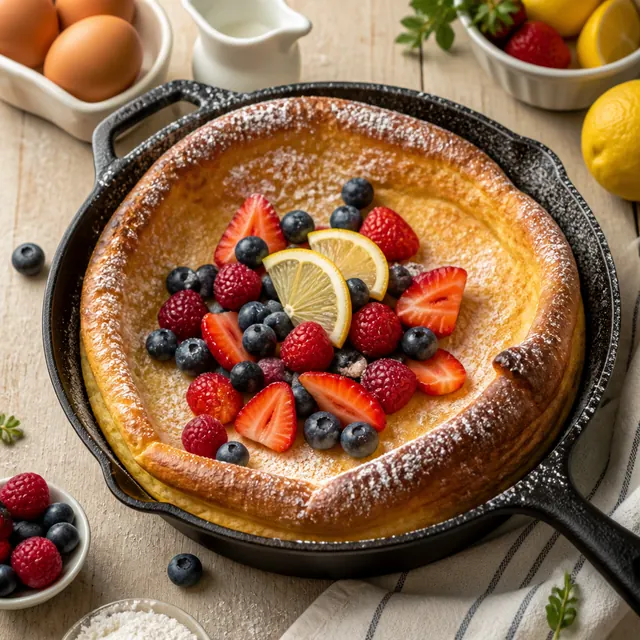

Serve it right away with lemon and powdered sugar, because the dramatic puff settles within a minute or two.
The science: why this works
- A very hot pan sets the batter instantly, which creates the crisp edges and the rapid rise.
- Water in the milk and eggs turns to steam in the hot oven and pushes the pancake upward.
- Room temperature eggs and milk blend into a smooth batter that heats evenly.
- Eggs give the structure that traps the steam, so the pancake holds its tall shape for a few minutes.
- Butter in the hot pan browns slightly and flavors the crisp bottom.
Steam is the leavener
A Dutch baby uses no baking powder. The thin, eggy batter hits a very hot pan, and the water in it flashes to steam. Egg proteins set around the expanding steam, trapping it and forming the tall, hollow puff.
Learn: Choux pastry and steam →Why you preheat the pan
A hot pan gives a strong burst of heat from below, so the outside sets quickly and the walls climb the sides before the middle sets. A cold pan heats slowly, and the batter spreads flat instead of puffing.
Learn: Preheat pans and ovens fully →Dutch Baby Pancake
30 min · 4 servings · American · Breakfast
Ingredients
Makes 4 servings
- 3eggs, room temperature
- 90 gcup (90 g) all-purpose flour
- 180 mlcup (180 ml) whole milk, room temperature
- 1 tbspsugar
- ¼ tspsalt
- ½ tspvanilla extract
- 3 tbspbutter
- 1lemon, cut in wedges
- Powdered sugar, for dusting
- 240 mlfresh berries, for serving
Method

Tips for the best result
- Warm the milk and eggs to room temperature for the biggest rise.
- Do not open the oven for the first 15 minutes or the pancake can collapse.
- Use an oven mitt on the handle; it will be extremely hot.
Mistakes to avoid
- Skipping the pan preheat gives a flat, dense pancake, so heat the skillet for 15 minutes.
- Opening the oven too early lets out heat and deflates the puff, so wait.
- Waiting to serve means it deflates, so bring it straight to the table.
Variations and swaps
- Apple cinnamon: saute sliced apples in the butter before adding the batter.
- Savory: skip sugar and vanilla, and top with Gruyere and chives.
- Chocolate hazelnut: spread with hazelnut spread and add banana.
- Swap whole milk for 2 percent milk; the pancake is slightly less rich.
- Swap the cast iron for an oven-safe stainless steel pan; the edges are a bit less crisp.
- Swap lemon for maple syrup for a sweeter finish.
Storing and reheating
Dutch babies are best eaten fresh. Refrigerate leftovers for up to 2 days and reheat in a 350°F (175°C) oven for 8 minutes, until hot throughout. Expect them to be denser.
Dutch Baby Pancake: questions
Why did my Dutch baby not puff?
It usually puffs poorly when the pan or oven was not hot enough, or the ingredients were cold. Preheat the skillet for 15 minutes and use room-temperature eggs and milk.
What is the difference between a Dutch baby and a regular pancake?
A Dutch baby is baked in a hot oven in one pan and puffs up by steam, with no leavening. A regular pancake is cooked in a skillet and rises from baking powder.
Can I use a different pan?
Yes, any oven-safe skillet works, such as stainless steel. Cast iron gives the crispest edges because it holds heat so well.
Why did my Dutch baby fall?
Every Dutch baby deflates as it cools because the steam escapes. Serve it right away to enjoy the puff.
Can I make Dutch baby batter ahead?
Yes, store the batter in the fridge for up to 24 hours, and let it come to room temperature for 30 minutes, then reblend before baking.