Classic Crème Brûlée
Crème brûlée is a silky vanilla custard under a thin, crackly layer of caramelized sugar. Breaking the top with a spoon is half the fun.
- 1 hTotal time
- 6Servings
- 370kcal / serving
- 5 gProtein
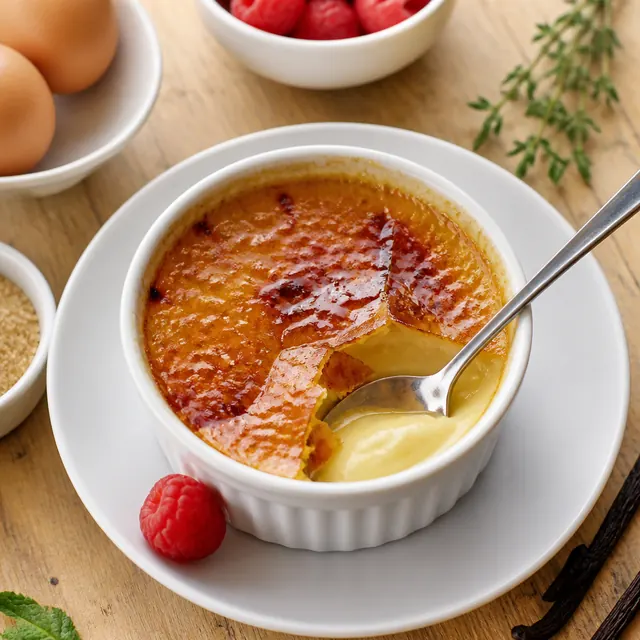

It only needs cream, egg yolks, sugar and vanilla. A gentle water bath bake and a long chill give a smooth, creamy custard, and a quick torch makes the brittle top.
The science: why this works
- Egg yolks alone give a rich, creamy custard with no egg-white firmness.
- Warm cream added slowly tempers the yolks, so they do not scramble.
- Straining removes any bits of cooked egg and foam, so the custard is perfectly smooth.
- The water bath keeps the heat gentle and even, so the custard sets softly without curdling.
- Chilling firms the custard, so it holds up under the hot caramel.
How custard sets
Egg proteins start to thicken around 160°F (71°C) and set firmly near 180°F (82°C). In a gentle oven, they link into a soft network that traps the cream. Overheating makes the network tighten, squeeze out water and turn the custard grainy.
Learn: Setting custard gently →Why a water bath
Water can only reach 212°F (100°C), and it absorbs a lot of energy. A bath around the ramekins buffers the oven, so the custard heats slowly and evenly from the edge to the center. Without it, the edges overcook before the middle sets.
Learn: Cook eggs gently →How sugar caramelizes
Sugar melts around 320°F (160°C) and starts to turn amber and bitter-sweet near 350°F (177°C). A thin layer melts quickly under a torch and cools into a glassy sheet. Too thick and it stays gritty, while too long and it burns.
Learn: Caramelize sugar without burning →Classic Crème Brûlée
1 h · 6 servings · French · Dessert
Ingredients
Makes 6 servings
- 480 mlheavy cream (2 cups)
- 1 piecevanilla bean, split, or 1 tbsp vanilla bean paste
- 5large egg yolks
- 75 ggranulated sugar (1/3 cup)
- ⅛ tspfine salt
- 6 tspturbinado or granulated sugar, for the tops
Method

Tips for the best result
- Pat the chilled custard tops dry with a paper towel so the sugar caramelizes evenly.
- Use a thin, even layer of sugar for the crispest top.
- Torch just before serving, since the crust softens within an hour.
Mistakes to avoid
- Overbaking makes grainy, curdled custard, so pull it while the centers still jiggle.
- Adding hot cream too fast scrambles the yolks, so pour slowly while whisking.
- Caramelizing the sugar too early makes it soggy, so torch right before serving.
Variations and swaps
- Infuse the cream with espresso beans or orange peel instead of vanilla.
- Add 1 tbsp coffee liqueur to the custard.
- Serve with fresh raspberries.
- Swap the vanilla bean for 2 tsp pure vanilla extract added after straining.
- Swap turbinado sugar for white sugar, which makes a thinner, more brittle top.
- Swap half the cream for whole milk for a lighter custard.
Storing and reheating
Refrigerate the uncaramelized custards, covered, for up to 3 days. Torch the sugar just before serving. The caramelized top will soften after about an hour.
Classic Crème Brûlée: questions
Can I make crème brûlée without a torch?
Yes. Place the chilled custards on a baking sheet under a very hot broiler, on the top rack, for 2 to 3 minutes. Watch closely, since the sugar burns quickly.
How do I know crème brûlée is done?
The edges are set and the center still jiggles slightly like gelatin, about 170°F (77°C). It firms up as it chills, so do not bake it until it is stiff.
Why is my crème brûlée runny?
It was underbaked or not chilled long enough. Bake until the centers only just jiggle and chill for at least 4 hours.
Why is my crème brûlée grainy or scrambled?
The oven was too hot, the cream was added too fast, or the custard overbaked. Use a water bath and whisk the cream in slowly.
What kind of sugar is best for the top?
Turbinado gives a thick, golden crackly top, while white granulated gives a thinner, more brittle one. Either works with a thin, even layer.