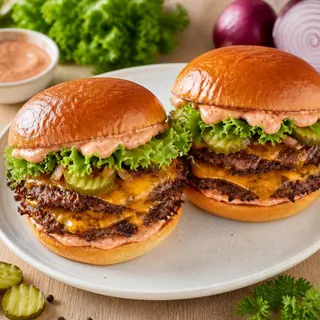
Fat in burgers

Beef with about 20 percent fat makes a juicy burger, because the fat melts and coats the meat. Very lean beef, like 95 percent lean, has little fat to melt, so the burger turns dry and crumbly. Cook burgers to 71°C (160°F).
Handle the meat lightly
Overworked ground beef gets tight and bouncy. Shape patties gently from cold meat. Press a shallow dimple into the middle so they don't puff into a ball, and keep them in the fridge until they hit the pan.

Test yourself
Questions from the interactive lesson, with the answer and the why.
You're buying beef for burgers. Which gives the juiciest patty?
80 percent lean, 20 percent fat. It has enough fat to melt and coat the meat as it cooks.
True or false: Pressing a burger flat with a spatula while it cooks keeps it juicy.
False. Pressing squeezes juice and melted fat into the pan, so the burger dries out.
What went wrong? You knead the beef with salt for five minutes before shaping. The burgers come out dense and sausage-like.
Salt and heavy mixing bound the proteins tightly. Salt and kneading make proteins sticky. Mix lightly and salt just before cooking.
Fill the blank: A burger made from very lean beef turns dry because there is little fat to ___ as it cooks.
A burger made from very lean beef turns dry because there is little fat to melt as it cooks. Melting fat coats the meat, and lean beef has little to melt.
Why press a shallow dimple into the center of a patty?
So it cooks flat instead of bulging in the middle. The edges shrink more than the center, so a dimple cancels the bulge.